Archive for December, 2009
Colors
Sunday, December 13th, 2009Information coming soon
Canvas and Paper
Sunday, December 13th, 2009Information coming soon
Brush and Paint
Sunday, December 13th, 2009Information coming soon
Blue and Green
Sunday, December 13th, 2009Information coming soon
READERS’ RESPONSES
If you have enjoyed reading or sharing this book, I would very much like to hear from you. Please click here to send your comments.
Artist’s Easel
Sunday, December 13th, 2009Information coming soon
Canción de todos los niños del mundo
Monday, December 7th, 2009BOOK DESCRIPTION
Striking photographs of children around the world are depicted to highlight the diversity of their environment as well as show the universal similarities of childhood.
One of Alma Flor Ada’s most well known poems, “Canción de todos los niños del mundo,” first appeared in the book A la sombra de un ala. When it was included in the Hagamos caminos series, Suni Paz set it to music. It can be found now in El son del sol, number 10 of the collection Música amiga.
When Houghton Mifflin decided to turn the song into a book, they selected excellent photographs that highlight what children in other parts of the world do in contrast with what children do in the United States. The book beautifully carries the poem’s message:
Canción de todos los niños
Alma Flor Ada
Cuando aquí es de noche
para ti amanece.
Estamos muy lejos
¿no te lo parece?
Cuando aquí es verano
allí usan abrigo.
Si estamos tan lejos,
¿seremos amigos?
Yo no hablo tu idioma
tú no hablas el mío.
Pero tú te ríes,
cuando yo me río.
Estudias, estudio,
aprendo y aprendes.
Sueñas y yo sueño.
Sé que me comprendes.
Vivimos muy lejos.
No estamos cercanos.
Pero yo te digo
que somos hermanos.
Song of all children of the World
Alma Flor Ada
When it is nighttime here
the day breaks for you
We are very far away,
don’t you think so?
When it’s summer here
you are wearing a coat.
If we are so far away,
can we possibly be friends?
I don’t speak your language
and you do not speak mine.
But you laugh
when I laugh.
You study, I study,
I learn and you learn.
You dream and I dream.
I know you understand me.
We live very far away.
we are not close by.
But I assure you
we are brothers, you and I.
CASSETTE AND CD DESCRIPTION
Suni Paz has created engaging music for this poem. Suni makes it very easy for everyone to sing along; children can say all the words or simply do the chorus.
The cassette titled Canción de todos los niños also contains a few complementary songs. In CD format “Canción de todos los niños” is one of the 12 songs contained in El son del sol, number 10 of the collection Música amiga.
AUTHOR’S NOTE
This poem is very important to me, because I firmly believe that all human beings are indeed brothers. To have Suni Paz create such wonderful music for this song has been an extraordinary gift and the occasions where I have been present as she sang it with audiences, or as children sang it for me, have been moments of great joy in my life.
That some enlightened editor at Houghton Mifflin could see that this poem could be transformed into a book, without me knowing anything about it, was an incomparable surprise. It pleases me that both the music and the photos can enhance the message and contribute to make it accessible to children.
READERS’ RESPONSES
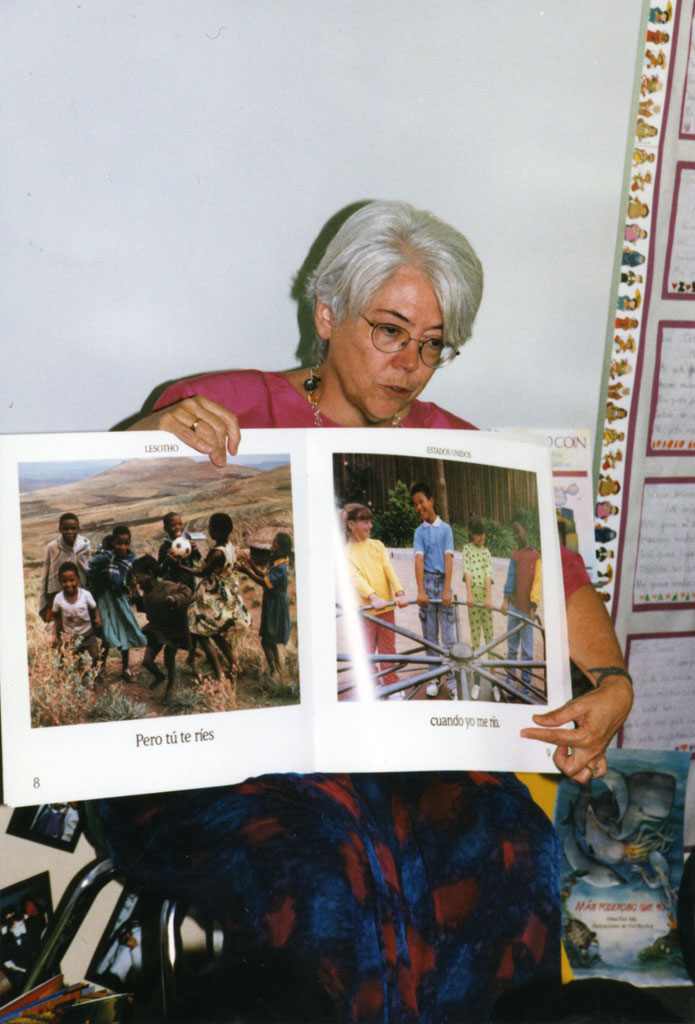
If you have enjoyed reading or sharing this book or CD, I would very much like to hear from you. Please click here to send your comments.
Acto final
Monday, December 7th, 2009BOOK DESCRIPTION
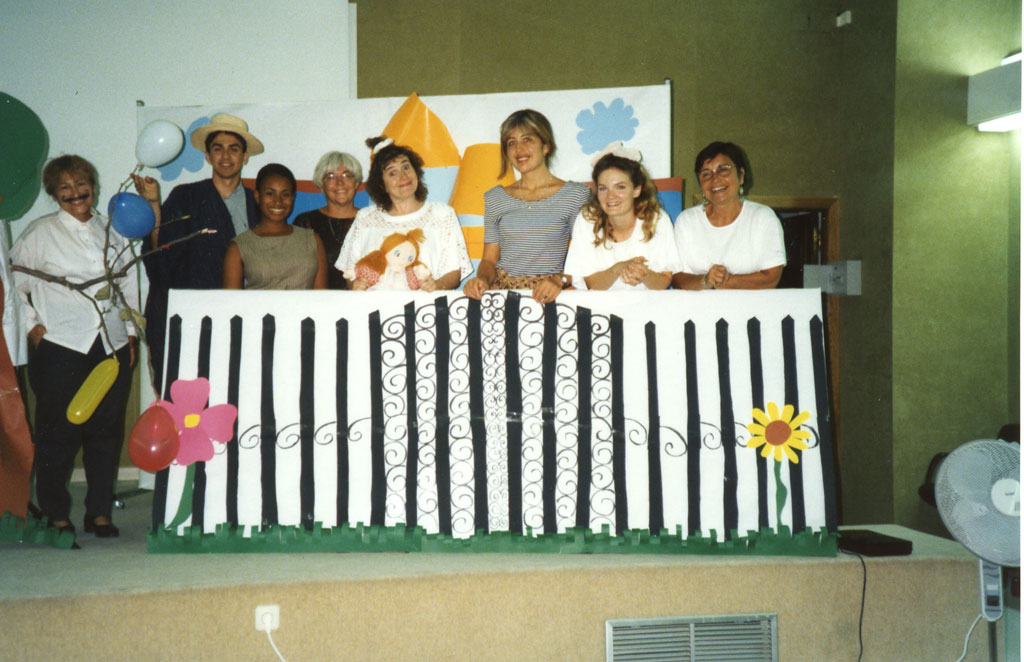
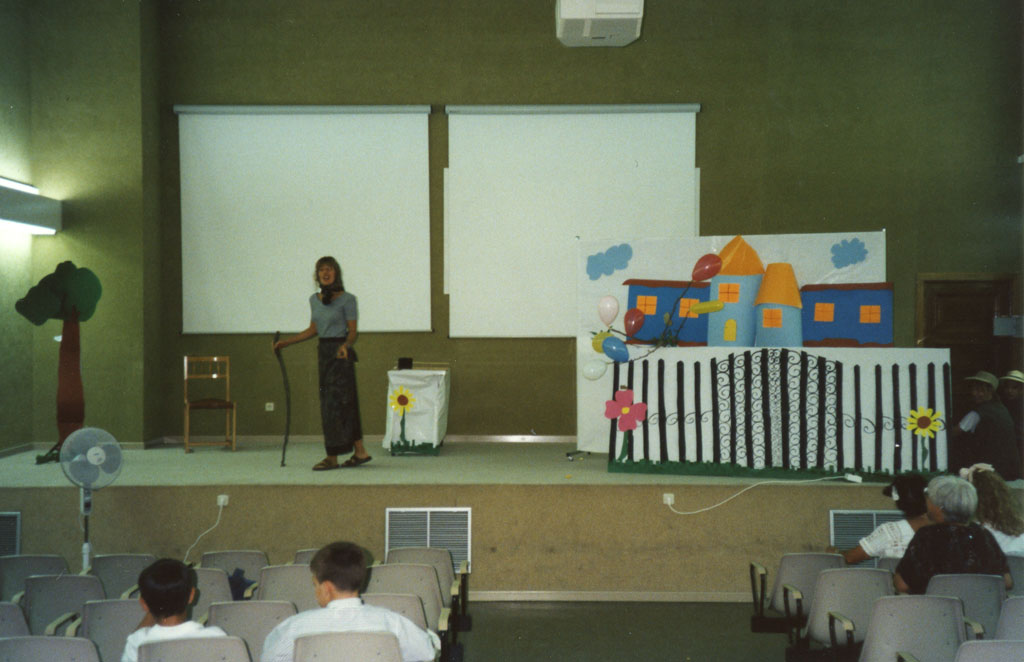
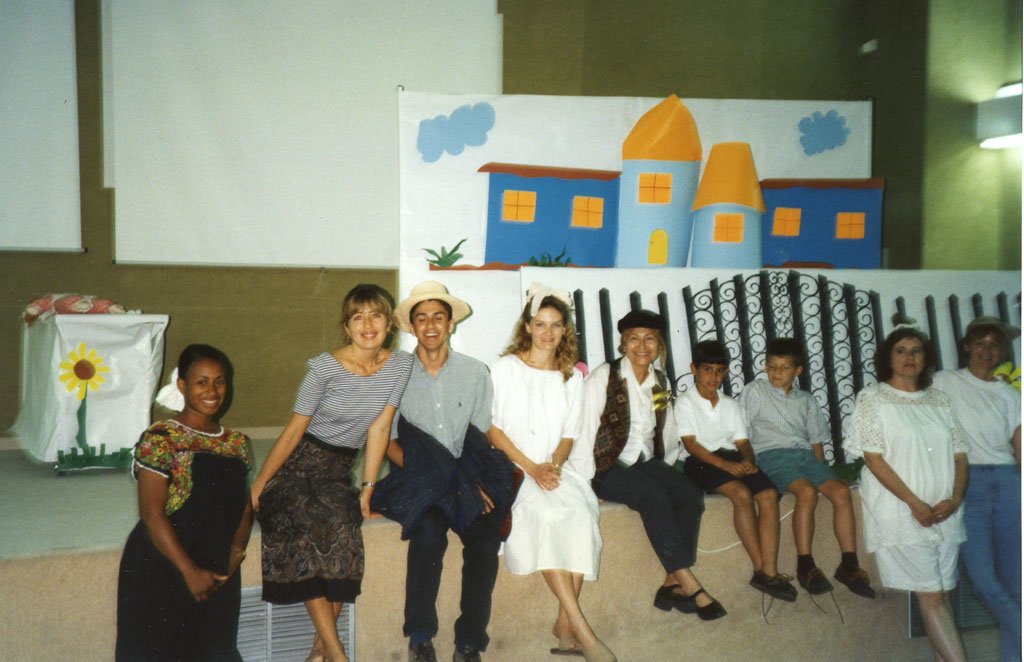
This theatre anthology includes four plays. La niña que riega la albahaca y el príncipe preguntón is a delightful play by Federico García Lorca, one of the greatest playwrights in the Hispanic theatrical tradition. Aventura en la Antártida [An Adventure in Antartic] by Adriana Alarco Soldi and Haraganoff, El Pirata [Haraganoff, the Pirate] are contemporary plays created especially for children. La doncella guerrera [The maid warrior] is the dramatization of a famous medieval ballad.
The book also includes four sections that will teach children about various aspects of the theatre, and will facilitate their involvement with different forms of staging a play: Pasos a seguir en un montaje teatral. Las máscaras. Los títeres. Teatro de sombras.
USING THIS BOOK
The value of involving children with theatre are multiple. Plays can be an excellent tool for promoting the leadership skill of being able to speak in front of a group. Since they offer children the opportunity to utilize words and language registries they may not have other opportunity to use, plays can be strong vehicle for vocabulary and language development.
When used for choral reading plays can strengthen reading skills. In addition, acting in a play enhances children’s self-confidence and self-esteem while providing opportunities to learn about one’s self and others. Most importantly, putting on a play, no matter how simple, promotes the values of collaboration and solidarity.
To read more on the significance of theatre click here: Let’s Raise the Curtain! The Benefit of Theatre in the School and for suggestions on its use in the classroom read the section “Plays and Dramatic Games” in Chapter 3 of A Magical Encounter: Latino Children’s Literature in the Classroom and for dramatic responses to books, the section “Promoting Dramatic Expression” in Chapter 4 of that same book.
AUTHOR’S NOTE
Ensuring that children have access to read and act in plays has always been one of my basic concerns. Even if it is done with great simplicity acting in a play can have very positive results. It certainly was so for me. Encouraged by my extraordinary sixth grade teacher, Dra. Rosa María Peyrellade, I wrote my first play which we performed in class. As a high school student I wrote three plays, and while very simple, my classmates performed them with enthusiasm. We invited the High School Faculty of the Instituto de Camagüey to the premier of one of them, which I entitled La sonámbula or The Sleep-walker. Even though some of the professors did not enjoy the criticism to their very traditional pedagogy which was part of the performance, there was enough interested public that we rented the best theatre in town, el Teatro Principal to give a couple of public performances.
When I became a High School teacher at the Colegio Abraham Lincoln in Lima, Perú, I invited my students to do theatre and we had great fun doing so!
My mother, a coordinator for FLES [Foreign Language in the Elementary School] in Atlanta, Georgia, used theatre very effectively in the teaching of Spanish, and wrote a number of plays that were performed by children and broadcasted via the district TV station.
As a teacher educator in the United States I have continuously emphasized the use of theatre. I have had the privilege of having my mother co-direct with me three different performances of Historia de una muñeca abandonada, by Alfonso Sastre during three summer courses: at the University of Texas, at El Paso, in Philadelphia, and in Puerto Rico. I was later able to continue to invite teachers to perform this outstanding play, in Chicago, through the Associate Colleges of the Midwest, and in Madrid, both at the Universidad Complutense and at the Fundación José Ortega y Gasset. This play is included in the anthology Ensayo general in this collection.
I am convinced that one is better able to teach something one has enjoyed doing. And just as Isabel Campoy and I emphasize, in our courses in Authors in the Classroom, that teachers who create their own books will be better able to get their students to become authors, I believe that encouraging teachers to do theatre and experiencing the richness of the process would better allow them to incorporate plays in their regular teaching.
For a delightful anecdote that shows the magic of theatre click here: Let’s Raise the Curtain! The Benefit of Theatre in the School.
You can also find more about my personal experience with theatre in the section “It’s Play Time!” in Alma Flor Ada and You volume II, published by Libraries Unlimited.
ABOUT ¡CURTAINS UP! THE CIELO ABIERTO THEATRE COLLECTION
Each of the seven anthologies in this series offers a variety of plays well-suited for either reading aloud or for full-scale performance. For the early grades, Alma Flor Ada and F. Isabel Campoy have created original adaptations of traditional children’s stories. Familiar tales are retold in the form of plays, choral poems, and theatre games, inviting children to explore movement, characterization, and imaginative play. The use of traditional Hispanic folklore, woven into the dialogue, enhances the cultural setting in which the stories have been recast. For the older grades, a selection of the best plays written for children throughout the Spanish-speaking world has been carefully assembled.
The anthologies are:
- Primer acto [PreK-2] 48 pages
- Risas y aplausos [K-3] 48 pages
- Escenas y alegrías [1-4] 48 pages
- Actores y flores [3-6] 64 pages
- Ensayo general [4-7] 80 pages
- Saludos al público [5-8] 96 pages
- Acto final [5-8] 96 pages
Teachers have found the anthologies in this collection both inviting and inspiring.
READERS’ RESPONSES
If you have enjoyed reading or sharing this book, I would very much like to hear from you. Please click here to send your comments.
A New Job for Pérez, the Mouse
Monday, December 7th, 2009BOOK DESCRIPTION
The protagonist of A New Job for Pérez, the Mouse or Ratoncito Pérez, cartero is a beloved character in the folklore of many Spanish-speaking countries. He is both known as Cucarachita Martina’s husband and as the equivalent of the tooth fairy.
In this story he is suffering because most children in the neighborhood have already lost their baby teeth. He is happy to find a new job, as a mailman, until his good friend Pig Three declares that mailmen are useless now that all correspondence happens through email.
But there is a surprise waiting for Pig Three that will vindicate Pérez’s job. And throughout the story readers get to see some of the diverse and fantastic mail that Pérez has delivered.
ON THE LANGUAGE BOOKS OF GATEWAYS TO THE SUN SERIES
The four books in the Language series of Gateways to the Sun or Puertas al Sol are fractured fairy-tales which will help to develop children’s language in very specific areas:
By predicting who are the characters, and then reading their first person descriptions in: One, Two, Three. Who Can It Be? or Uno, dos, tres. ¡Dime, quién es children will become acquainted with personal descriptions and familiarize with language that will help them talk about themselves.
A New Home for the Seven Little Kids or El nuevo hogar de los siete cabritos shows all the elements of a house. Children will be able to understand a plan for the rooms of a house and will find the vocabulary related to furniture and appliances.
In Happy Birthday, Little Red Riding Hood or ¡Feliz cumpleaños, Caperucita Roja! children will follow Little Red Riding Hood and her mother as they plan a birthday party. Creating the list of guests, writing the invitations, looking for addresses in an address book, writing the envelopes, making a shopping list, and following some simple recipes all will contribute to see the many ways in which language is present in daily life.
AUTHOR’S NOTE
Reintroducing well loved characters from fairy tales has always been an enjoyable form to create a book. After the success of the Hidden Forest series, Dear Peter Rabbit or Querido Pedrín, Yours truly, Goldilocks or Atentamente, Ricitos de Oro, With Love, Little Red Hen and the recent Extra! Extra! Fairy Tales News from Hidden Forest or ¡Extra! ¡Extra! Noticias del Bosque Escondido to continue to play with fairy tales characters seemed just a natural thing to do.
CONNECTIONS
Besides the connections between the four books of this series of Gateways to the Sun, there are multiple connections to these characters in other titles.
The complete traditional tale of Ratoncito Pérez or Pérez the Mouse can be found as “Martina Martínez and Pérez, the Mouse” or “Martina Martínez y el ratoncito Pérez” in Tales Our Abuelitas Told or Cuentos que contaban nuestras abuelas.
A delightful song La Cucarachita Martina offers a brief version of the encounter between Martina and Pérez. It can be found in “Sigue la música,” number 7 of the collection Música amiga.
A different take on the story is presented in the great-granddaughter of Cucarachita Martina o La tataranieta de Cucarachita Martina which brings the story to present times.
READERS’ RESPONSES
If you have enjoyed reading or sharing this book, I would very much like to hear from you. Please click here to send your comments.
